
Ingredient Inventory Examples for Home Bars
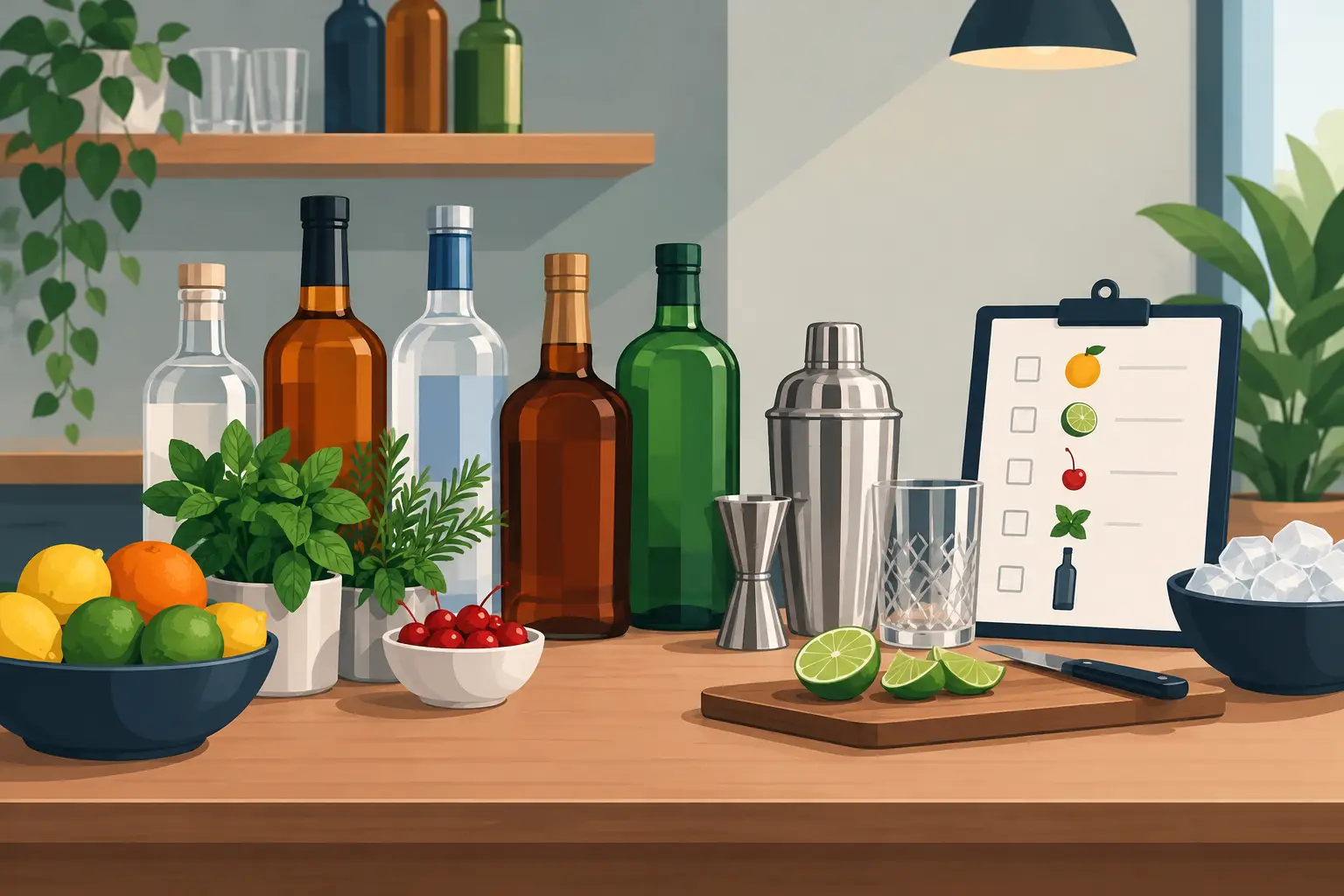
A bottle shelf can look well stocked while still leaving you unable to make a good drink. That is why useful ingredient inventory examples do more than list what you own. They show the form, amount, freshness, and cocktail role of each item, so you can see what is ready now and what is actually missing.
For a home bar, the goal is not restaurant-level stocktaking. It is a clear picture of your bottles, mixers, and perishables that leads to better decisions: make a familiar classic, use an open bottle before it fades, or buy one ingredient that meaningfully expands your options.
What a cocktail ingredient inventory should track
A basic list of “gin, rum, lemons” is better than nothing, but it cannot reliably tell you whether a recipe will work. A Martini may be possible with gin, for example, but only if you also have dry vermouth. A Daiquiri needs rum, lime, and sugar or simple syrup, not lemon juice and tonic water.
For each ingredient, record the name, category, approximate quantity, and status. Status can be as simple as open, unopened, fresh, or needs replacing. Add a short note only when it changes how you would use the ingredient, such as “half bottle,” “very dry,” or “best by Friday.”
The distinctions matter most for three groups. Spirits tend to last, but an almost-empty bottle can rule out several servings. Vermouth, cream liqueurs, juices, herbs, and syrups have more limited useful lives after opening. Finally, similarly named ingredients are not always interchangeable: coconut cream and cream of coconut, sweet vermouth and dry vermouth, and soda water and tonic each do different jobs in a drink.
Ingredient inventory examples by home-bar stage
The right inventory depends on how you drink and host. A couple who makes one or two classics on weekends needs a different setup from someone planning a birthday menu for 12 guests. These examples show enough detail to make recipe matching practical without turning the exercise into paperwork.
Example 1: The compact apartment bar
This inventory suits a beginner or a small household with limited cabinet space.
| Ingredient | Type | Amount or status | Notes | | --- | --- | --- | --- | | London dry gin | Spirit | About 18 oz | Open | | Bourbon | Spirit | About 12 oz | Open | | Blanco tequila | Spirit | 750 ml | Unopened | | Sweet vermouth | Fortified wine | About 10 oz | Refrigerated, opened recently | | Dry vermouth | Fortified wine | About 8 oz | Refrigerated | | Campari | Bitter aperitif | About 14 oz | Open | | Orange liqueur | Liqueur | About 9 oz | Open | | Simple syrup | Syrup | About 6 oz | Dated bottle | | Angostura bitters | Bitters | Nearly full | Open | | Lemons | Fresh | 4 | Use first | | Limes | Fresh | 5 | Good condition | | Soda water | Mixer | 4 cans | Chilled |
This is a small inventory, but it supports focused choices. Gin, dry vermouth, and a lemon make a Martini variation or a Gin Sour, depending on the remaining ingredients. Bourbon, simple syrup, Angostura, and citrus point toward an Old Fashioned or Whiskey Sour. Tequila, orange liqueur, lime, and simple syrup make a Margarita possible if you are comfortable using syrup in place of another sweetener.
The meaningful gap is not “buy everything.” If the household prefers tequila drinks, purchasing a bottle of soda water or grapefruit soda may expand the bar more than adding a fourth base spirit. If it prefers stirred classics, a replenishment of vermouth may matter more than another liqueur.
Example 2: The classic-cocktail home bar
This version is for someone who has accumulated bottles and wants a useful way to organize them.
| Category | Ingredients on hand | Inventory note | | --- | --- | --- | | Base spirits | Gin, bourbon, rye, blanco tequila, aged rum, vodka | Record bottle level for each | | Fortified wines | Sweet vermouth, dry vermouth, fino sherry | Date opened bottles and refrigerate | | Liqueurs and aperitifs | Campari, Aperol, orange liqueur, maraschino liqueur, coffee liqueur | Identify bottles used rarely | | Sweeteners | Simple syrup, demerara syrup, honey syrup, grenadine | Label date made or opened | | Bitters | Angostura, orange, Peychaud’s | Usually long-lasting, but track availability | | Fresh ingredients | Lemons, limes, oranges, mint | Update weekly | | Mixers | Soda water, tonic water, ginger beer | Count individual cans or bottles |
This inventory is broad enough to create a misleading sense of completeness. The practical question is which recipes are one meaningful item away. Maybe you have rye, sweet vermouth, Angostura, and an orange, but no maraschino liqueur for a Manhattan variation you want to try. Or perhaps several gin drinks are blocked only by fresh lemon juice.
Treat the fresh section as a live layer on top of the bottle list. You may technically own the ingredients for a Southside, but wilted mint changes the answer. A reliable inventory says “mint: none” rather than assuming last week’s bunch is still usable.
Example 3: The party inventory
A party list needs quantities, not just presence. One bottle of tequila may be enough for a few Margaritas but not for a group of 10, especially if it is also the base for a second drink option.
For a gathering, organize the inventory around the menu. Suppose you plan to serve Margaritas, Ranch Water, and a nonalcoholic citrus spritz. Your list might show: 1.75 liters blanco tequila, 24 limes, 750 ml orange liqueur, 32 ounces simple syrup, two cases of sparkling water, 24 ounces grapefruit soda, ice, salt, oranges, and nonalcoholic aperitif.
Then add a serving estimate next to each menu ingredient. A standard Margarita at 2 ounces of tequila uses roughly 16 ounces for eight drinks, before allowing for generous pours or repeat rounds. That does not mean every party requires exact forecasting. It means the inventory should flag the ingredients that can stop service early: ice, citrus, carbonated mixers, and the primary spirit.
Keep a small buffer for the ingredients shared across drinks. Limes may cover both Margaritas and Ranch Water, so counting them against one drink at a time creates a false sense of supply. For parties, simplify where possible. Two well-supported drinks are usually more useful than six recipes that each require a specialty bottle.
How to turn your inventory into drink decisions
Start from what is already open and perishable. Fresh citrus, herbs, opened vermouth, and prepared syrups should guide the first round of recipe searches because they carry the highest waste risk. Next, select a base spirit you feel like using and check which recipes are complete rather than improvising around a missing core ingredient.
When a recipe is missing something, classify the gap. A missing lemon can be a quick store run. A missing liqueur may be a purchase worth considering only if it opens several drinks you genuinely want to make. A missing bitters might be optional in some recipes but defining in others. This is where substitutes need restraint: using lime instead of lemon changes the drink; replacing dry vermouth with sweet vermouth changes it more.
Kokto’s inventory-first approach is built for this kind of decision. Its recipe library can distinguish drinks you can make from those that are one ingredient away, while keeping the full recipe context visible. That is more useful than a vague recommendation because you can see the real gap before buying another bottle.
A simple weekly maintenance routine
Update the inventory after grocery shopping, before hosting, and when a bottle runs out. Those moments take less time than attempting a full reset after months of collecting. If your bar is growing, use a consistent naming convention: “orange liqueur” is a category, while “Cointreau” is a specific bottle; record whichever level of detail helps you make decisions.
Do not overstate what you have. Mark an ingredient unavailable when there is too little for a normal serving, when citrus is dried out, or when a refrigerated product is past its useful window. A slightly shorter list produces more dependable cocktail suggestions than an optimistic one.
Your next drink does not need to begin with a new recipe or a new purchase. Check the ingredients already asking to be used, choose a recipe that respects them, and let the inventory make the decision simpler.