
How to Use a Cocktail Jigger Without Guessing
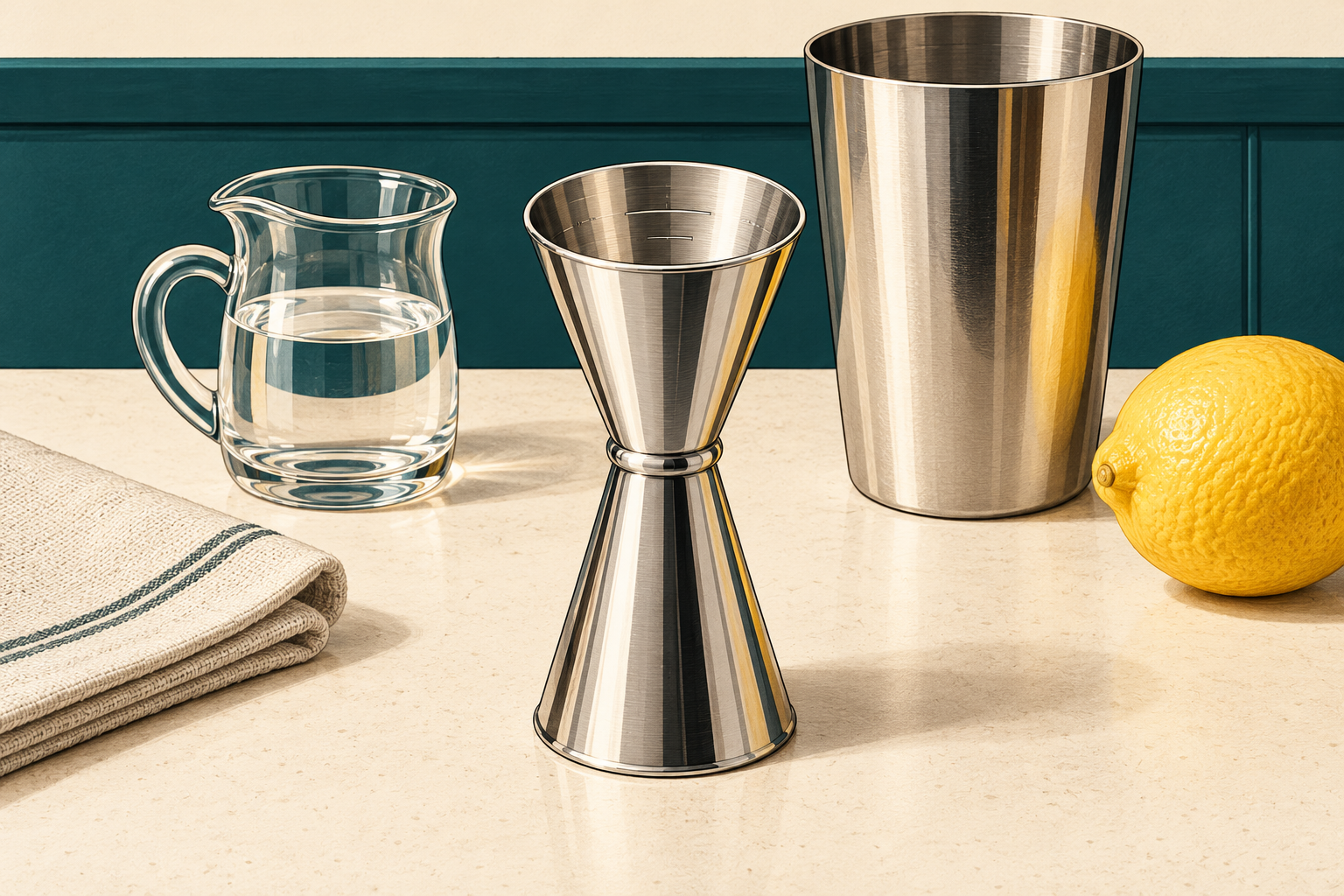
A jigger is useful only when you know what you are filling. The top of a small cup, an etched line inside a larger cup and a mark on an angled surface are not interchangeable targets. Before opening a bottle, take a moment to match the recipe to the tool in your hand.
Keep the full recipe open, use its written quantities, and follow its shaking, stirring and serving instructions.
Find the mark before you pour
Look at both ends of your jigger. Identify the units, the capacity of each cup and any smaller marked measures. Do not assume that every double-ended jigger holds the same amounts or that half the height means half the capacity.
Match each liquid ingredient to a clearly identified mark. If your tool cannot measure an amount directly, use a suitable graduated measure or a combination of known measures rather than guessing an unmarked level. For unit conversions, use Kokto's separate cocktail measurements guide.
Read your particular tool
A Bar Above's jigger guidance distinguishes between styles and notes that Japanese-style jiggers commonly include internal etched measures. A line inside the cup is a different target from a full cup: read the tool's own instructions before deciding where to stop.
An angled measure works differently again. OXO's Steel Angled Jigger is designed so its scale can be read from above. That feature belongs to that design; it is not a reason to read every side-marked vessel from the same angle.
Keep the jigger steady and level while checking the amount. Slow down as the liquid approaches the intended mark. Speed is not the goal at a home bar.
Practise the transfer with water
Before making a cocktail, try this short rehearsal with water and an empty mixing tin:
- Choose one clearly marked measure and fill to that target.
- Move the jigger close to the receiving vessel so the transfer is controlled.
- Tip the measured water into the vessel, watching for liquid left behind or spilled outside.
- Repeat at another marked measure until the movement feels comfortable.
Practise reading the mark and transferring the liquid as two separate steps. The aim is to build a comfortable movement before you handle your cocktail ingredients.
Watch what stays in the cup
A Bar Above recommends measuring thinner ingredients before thick ones because residue from a purée can interfere with the next measure. When a recipe's sequence allows it, leave thick ingredients until last. Do not rearrange a preparation step that the recipe specifically requires.
After a sticky ingredient, inspect the jigger before measuring something else. Follow the tool's cleaning instructions and start the next drink with a clean, drained measure rather than carrying residue between recipes.
Return to the whole recipe
Use the jigger for the liquid amounts in Kokto's Negroni recipe, then follow that page's stirring and serving method. Measuring is one step, not a replacement for the rest of the preparation.
For a first attempt, work through one drink at a time. Read the ingredient, identify the mark, measure, transfer, then move to the next ingredient. A simple repeatable sequence is more useful than trying to imitate a fast bartender.
Sources and editorial note
This original Kokto article uses the tool makers' guidance linked above and Kokto's published recipe and measurement guide. References were checked on 4 November 2026. The water exercise is handling practice rather than a test of the jigger's capacity.